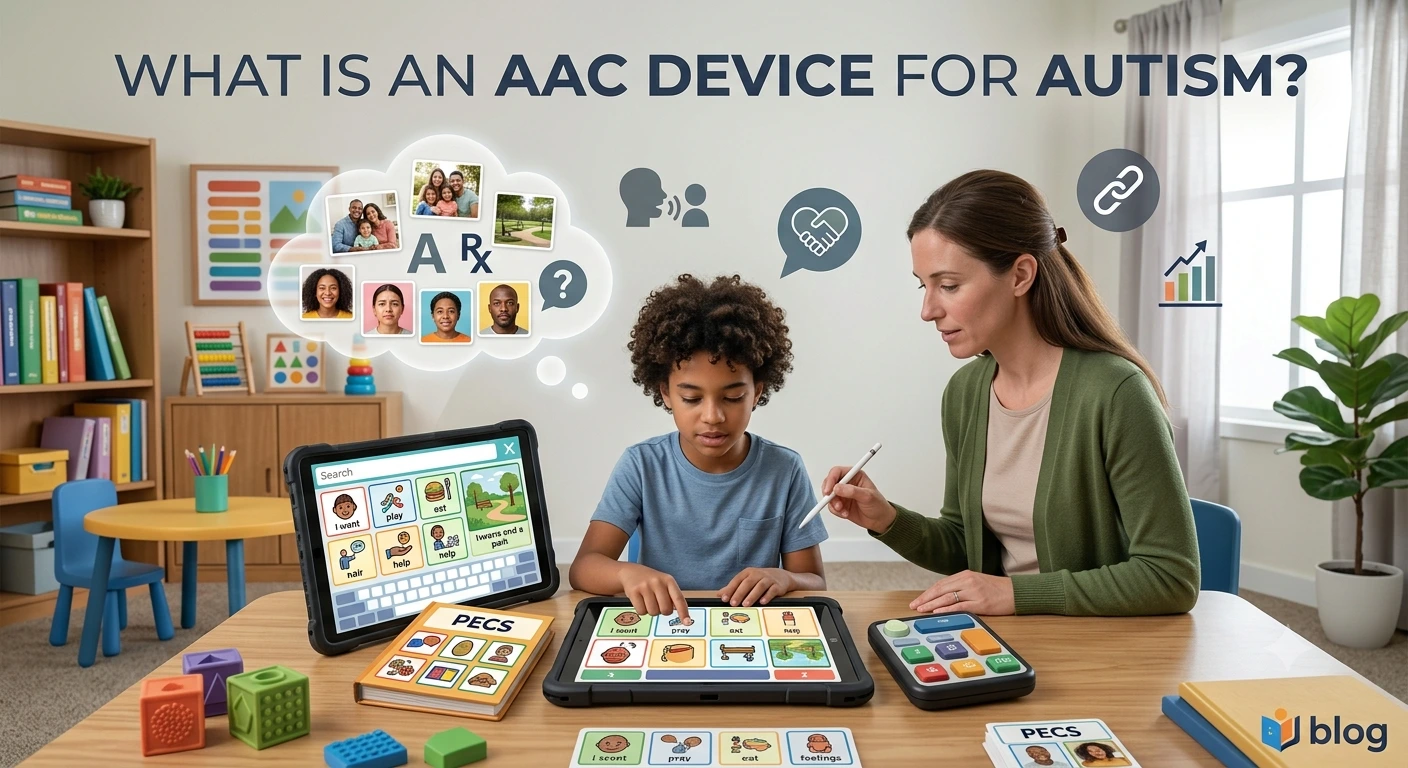
Regardless of everything else, both parents want to know what their child means. If a kid has autism and has problems with communication, any of their actions can be very stressful for the kid themselves and also for their parents. The AAC device for autism is an instrument that helps children communicate their feelings and needs, which they cannot otherwise express through speech.
There are various communication methods for autistic children. These include speaking, pictorial language, signing, and the use of devices. Each child should have the chance to communicate, and AAC tools will provide that opportunity. They will provide your kids with the opportunities they need to actively participate in the life of your family, school, community, etc.
Here, you will learn what AAC is, the different types of AAC, common misconceptions about AAC, effective ways to implement AAC, and why you should opt for AAC for your kids with autism spectrum disorder, as recommended by many speech therapists.
What Is an AAC Device for Autism?
An AAC device for autism is any device that enables a child to communicate when verbal communication alone is insufficient. AAC stands for Augmentative and Alternative Communication. The term “augmentative” indicates that this tool enhances the child’s existing means of communication, while “alternative” implies an alternative method of communication.
AAC is much more than electronic devices. Children are also capable of communicating through pointing to pictures, through communication boards, gesturing, or exchanging pictures. Some children even use speech-generating devices that vocalize what they communicate by touching a specific picture or symbol.
In any case, children are provided with the chance to communicate whatever they want to say, express, and feel in this way. One must note that there is no universal AAC for each individual. There are many factors that speech-language pathologists consider, such as the child’s ability to communicate, motor, and cognitive abilities. If a child develops and changes, the AAC system does too.
Parents are concerned that their child might give up on speaking because of AAC. However, research suggests otherwise. AAC supports language development by giving children more chances to communicate successfully.
With the increase in communication capabilities, many children become increasingly fascinated by communicating with those around them.
Some typical examples of AAC may include:
- Picture Exchange Communication System (PECS)
- Picture and word boards
- Sign languages and gestures
- Speech Generating Devices
- Language apps such as LAMP Words for Life
All children are different and unique in their own ways. The right form of AAC can be determined based on the child’s strengths and weaknesses.
AAC Myth and Misconceptions
Sometimes parents get misguided about how AAC works because of misconceptions. It would be helpful to learn some facts and truths that could help you decide.
Myth #1: AAC for Non-verbal Children Only
One of the most frequent mistakes made about AAC methods is that these methods are meant for non-verbal children only. In reality, AAC methods can be utilized by any child, irrespective of their language skills.
Some children can speak in specific phrases and sentences, yet cannot convey their thoughts or demands. There are children who communicate very successfully at home and have issues elsewhere.
By providing additional support, AAC enables children to structure their thoughts and express themselves more effectively. The child can combine speech with pictures or symbols and, in certain cases, even a speech-generating device.
The use of communication does not have to be either-or; indeed, many children successfully communicate using different types of communication at once.
Providing children with additional opportunities to communicate enables them to practice communication skills without being limited.
Myth #2: AAC Hinders Communication Development
This is one of the greatest fears among parents, but there is no evidence to support it. Scientific studies show that AAC doesn’t delay speech development. Sometimes, quite the opposite occurs: children develop their communication skills even faster because they become less frustrated and more successful at communicating with others.
Children feel encouraged to communicate in all possible ways when they realize that communication brings them what they want. Sometimes, children communicate more through speech; other children prefer AAC alongside speech. It all comes down to personal preference, but what is the ultimate goal here? Effective communication.
A speech-language pathologist will assess how a child is developing and change his communication techniques.
Myth #3: It is Difficult to Operate the AAC Device
Operating the AAC device can be hard for the parents because of things like pictures and buttons. But it is important to mention that children do not have to know everything from the beginning. Communication comes gradually.
The caregiver can use feeding, playing, telling stories, and even dressing the child up to model words. This may include the caregiver modeling “eat” before meal times and “go” on leaving.
Moreover, the speech-language therapist assists in integrating AAC into the child’s daily routines. AAC becomes a natural component of the routine due to systematic work and training.
Myth #4: My Child Will Always Need an AAC Device for Autism
One more misconception that is often made is that once a child begins to use AAC, he will always need it. Actually, every child is unique, and the AAC experience may vary.
While some kids may need AAC devices all the time, others may become increasingly verbal and begin to use their devices less and less. It happens that kids speak verbally and use AAC depending on the environment.
There isn’t a right or wrong outcome. It is not about stopping the use of the device. It is all about helping the kids communicate confidently. With improved communication skills, the therapists continue to assess the child’s progress and make adjustments to the system accordingly.
How to Implement an AAC Device for Autism
AAC implementation requires personalized assessment. The Speech-Language Pathologist assesses the child’s communication skills, learning approach, motor skills, and routines before recommending a system.
Parents have to integrate device use into daily activities rather than hold a separate AAC session. Daily activities like meals, bath time, playtime, and even sleep time can be great opportunities to communicate.
Adults must use words from the AAC tool along with regular conversation. Such an approach will help the child learn about the system without any pressure.
Consistency matters more than perfection. Some children begin using AAC quickly, while others need more time. Every successful interaction builds confidence and encourages future communication.
Many AAC systems also grow with the child. A beginner may start with only a few symbols before gradually accessing more vocabulary as communication skills improve. This flexibility allows the system to support development over time rather than limit it.
Due to the fact that communication difficulties often have an impact on a number of developmental domains, it is helpful for many families to consult a collaborative team comprising speech-language therapists, behavior analysts, occupational therapists, educators, and care providers.
Why AAC is So Helpful for Individuals with Autism
Communication support systems for children with autism can serve purposes beyond the ability to ask for food and toys. They can offer an opportunity for people to express their opinions, emotions, preferences, dislikes, questions, and experiences. When communication improves, self-esteem, engagement, and interactions with other children become significantly more productive and successful.
Frustration levels decrease as well. Many behaviors that adults view as challenging actually happen because children cannot express what they need. When children gain a dependable communication system, they often experience fewer moments of stress because others understand them more easily.
AAC also supports learning. Children can ask questions, contribute to class discussion, complete tasks, and interact with other children in ways that were maybe impossible before. Communication provides the means for independence in different spheres, including home, school, and the community.
Sometimes parents can observe some emotional changes too. Those kids who used to have difficulty expressing their discomfort, joy, or disappointment start getting involved once they learn to use a form of communication that suits them. Through every successful communication, it becomes clear that their voices are important regardless of how they may communicate.
If you are interested in learning more about the differences between developmental disabilities, please read our article “Are Autism and Down Syndrome the Same?”
Help Your Child Communicate with Reach Higher ABA
It is important for every child to have a way to communicate their thoughts and feelings. It’s okay if your child does not find it easy to communicate. Speech isn’t the only type of communication.
AAC technology does not restrict the development of a child’s capabilities. On the contrary, it opens up many new possibilities for learning, social interaction, and even greater independence in one’s activities. Whatever communication techniques your child may use to interact, be it verbal speech, visual aids, or a combination of various approaches, an early intervention can make a real difference. In collaboration with professional specialists, families will be able to select the most suitable communication methods for their particular child. At Reach Higher ABA, we recognize the uniqueness of every child’s communication process. That is why our team is ready to collaborate with parents to offer an individualized, quality-based ABA therapy in Utah that will contribute to every child’s overall growth. Do you want to know more about your child’s abilities or about our autism services? Contact Reach Higher ABA now!