
Every movement is felt. Every visit is planned. You hope that you know your baby is healthy before you have met them yet. Therefore, it is only natural that many expectant parents wonder secretly whether it is possible to determine in advance whether the child will be autistic.
The answer to the question is simple. The doctors are not able to diagnose the problem in the womb. None of the existing tests, ultrasounds, or other scans can provide information on whether or not your baby will be autistic. Nevertheless, many scientific studies have identified several risks which increase the possibility of the disorder. These symptoms do not predict the disease, they only indicate its high likelihood.
This article describes what science has learned so far about the early signs of autism in a developing child and why there is no test to confirm the diagnosis in advance.
Prenatal Indicators of Autism
Autism can’t be confirmed on an ultrasound screen or a lab report during pregnancy. What researchers discovered instead is that there are patterns. There are certain health conditions of the mother, certain genetic markers, and certain environmental factors that occur more frequently in pregnancies of children who later receive an autism diagnosis.
Doctors recognize these patterns based on medical histories, scans, and tests, not a prenatal autism test. None of these markers works alone. A mother could have every risk factor on this list and still have a neurotically child.
Another mother could have none of them and still have an autistic child. Autism develops through a mix of genes and environment working together, and researchers are still mapping out exactly how.
Maternal Health and Environmental Exposures
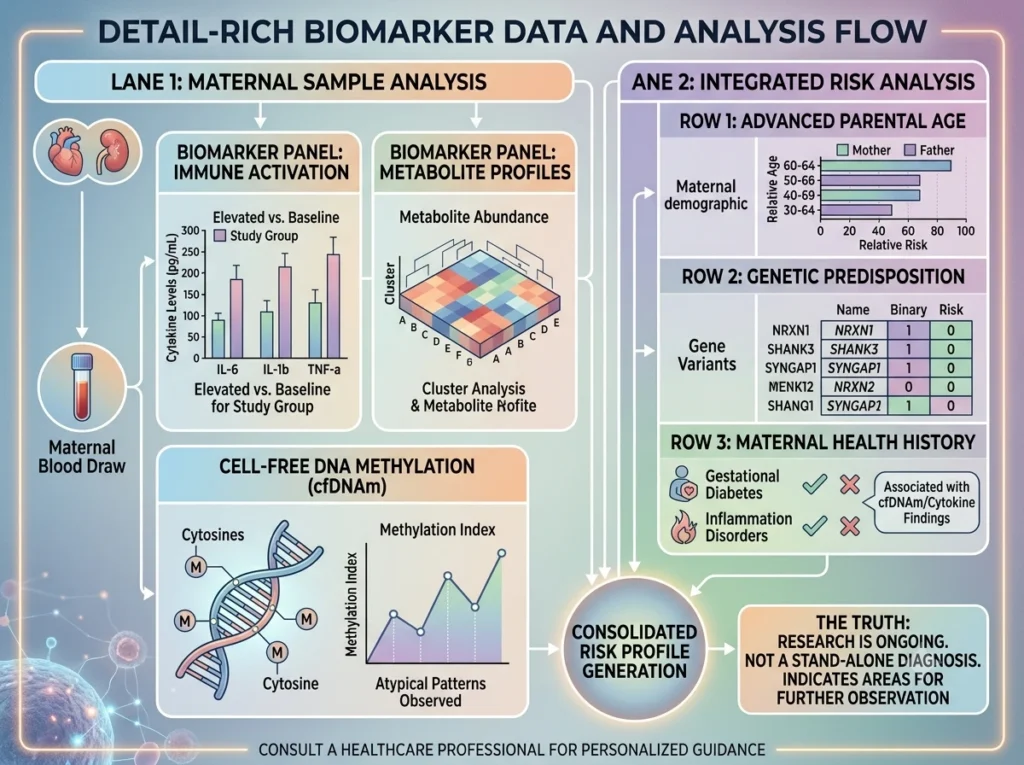
Whatever happens inside the mother’s body affects how the developing brain of the fetus grows. Research has proven that if a woman has gestational diabetes, is obese, or has autoimmune disease, then she is more likely to give birth to a baby with autism. The reason is that these environmental conditions affect the brain of the fetus at particular critical stages.
Environmental exposure also plays a significant role. Exposure to high levels of air pollution when the woman is pregnant, especially during the second and third trimester, has been associated with an increased risk of autism in many research studies. In addition, exposure to some specific types of pesticides and medications has been linked to autism as well. However, none of the exposures are a guarantee of the child being diagnosed with autism.
Genetic Factors
One of the most important factors associated with the risk of developing autism is genetics. When autism or some other neurodevelopmental disorder already occurs within the family, the risk increases for your child. Scientists have found out some particular genetic disorders such as Fragile X syndrome and Rett syndrome which have a high correlation with the development of autism.
The presence of such disorders can be diagnosed in advance during pregnancy using genetic screening. However, there is no guarantee that every autistic person has some specific gene because the majority of cases are associated with a complex set of many different genetic abnormalities.
Fetal Brain Development
The brain of an infant goes through extensive development even before birth. This involves the formation of neurons and connections which eventually form the structures involved in controlling language, emotions, and behavior.
In studies done on fetal MRI, subtle differences have been seen in brain areas such as the amygdala and cerebellum of infants who end up being diagnosed with autism spectrum disorder.
Although these are fascinating findings for researchers, it does not make a difference at the point of pregnancy visits since they can only be seen under special circumstances.
Abnormal Ultrasound Findings
The routine ultrasound tests that you undergo during pregnancy will take into account your baby’s head size and brain structure. Sometimes, a doctor will diagnose a bigger or smaller head than the normal, known as macrocephaly and microcephaly, in your baby.
Scientists have proven that there is a high likelihood of finding such occurrences in children who later are diagnosed with autism.
It is important for one to realize that some babies with different head sizes may not end up having autism but other disorders.
Maternal Immune Response
Your immune system does more than fight off colds during pregnancy. It can also contribute to the development of the brain of your child.
For example, infection of the mother during the pregnancy stage through rubella or cytomegalovirus infection has been associated with the development of autism in the child. Maternal chronic inflammatory diseases like rheumatoid arthritis behave in the same way.
This condition is known as maternal immune activation, and it is thought to interfere with the appropriate wiring of the brain. The exact mechanism through which this occurs is yet to be understood, although the relationship between maternal immunity and brain development is clear.
Advanced Imaging and Screening Tools
Advances in medical technology have helped us to monitor pregnancy to some degree, and there are quite a number of technologies that help us learn more about the development of the fetus. None of them will be able to diagnose autism; each of them is giving another piece of the puzzle.
Fetal Magnetic Resonance Imaging (MRI)
This technology helps to receive more accurate images of the brain during its development than traditional ultrasounds. Fetal MRI may show subtle differences in the brain structure, for example in corpus callosum, but it will be used only for monitoring purposes.
Non-Invasive Prenatal Testing (NIPT)
This test screens fetuses for the presence of different genetic abnormalities, including fragile X syndrome.
Genetic Screening
It is performed using amniocentesis or chorionic villus sampling and gives a chance to analyze the fetal DNA in order to identify genetic disorders that may cause autism in future.
All of these technologies help families in Utah and physicians to gather more data about the health condition of the fetus. They are just unable to provide an answer that every parent would want to know.
Why Autism Risk Is Complex, Not a Checklist
It’s tempting to read a list like this and start counting boxes. Try not to. Autism doesn’t work off a checklist. It emerges from an intricate overlap of genetics, prenatal environment, and factors researchers haven’t fully identified yet. A family can carry several risk factors and have a child with no signs of autism at all. Another family with no known risk factors at all can have an autistic child.
This complexity is exactly why doctors don’t diagnose autism before birth. The real value of understanding these risk factors isn’t prediction. It’s preparation. Knowing your child may have a higher likelihood of autism means you can watch their early development with informed eyes instead of guessing.
Early Monitoring and Intervention
In case your pregnancy is marked by any of the aforementioned risk factors, consult your pediatrician for further monitoring of development after delivery. Autistic children usually display the first symptoms between 12 and 24 months of age through deviations from typical eye contact, babbling, gesturing, and responding to name.
Timely diagnosis of autism results in improved outcomes. Early intervention with the help of speech therapy, occupational therapy, and Applied Behavior Analysis therapy contributes to better communication and social skills development.
There are numerous studies confirming the effectiveness of early intervention; this is exactly the reason why doctors recommend developmental screening during each visit to the pediatrician.
Parental Awareness and Support
Knowing is doing, not fretting. If you are pregnant and have concerns about the likelihood of autism, then you should discuss the different avenues of genetic testing available to you based on your medical history.
Following the birth of the baby, be mindful of the developmental markers evaluated by your pediatrician, as well as any instincts you might have about how the baby responds to their surroundings.
It is important to realize that you do not need to go through this on your own because there are resources out there that can help guide you in making the transition from concerns to action.
Where Research Is Headed
Research into the reasons for autism continues. Large-scale scientific endeavors, such as the Autism Sequencing Consortium, seek to identify genetic variations associated with autism susceptibility.
Environmental health research, such as that done through the Environmental Influences on Child Health Outcomes initiative, considers pollution, chemicals, and the mother’s health. None of this research points to a prenatal autism test arriving tomorrow.
But it’s building the foundation that could eventually make earlier, more accurate identification possible, and that benefits every family watching their child grow.
Moving Forward With Confidence
It is impossible to predict whether your child will be diagnosed with autism before their birth, which is understandably tough to come to terms with. However, you can stay informed and keep up with your child’s pediatrician while acting fast once there are signs of autism from an early age. This will ensure your child has the best chances of success in life development.
If your child has early autism signs or you just want to learn how to recognize them, contact Reach Higher ABA. We offer our personalized ABA therapy based on the individual needs of your child, helping them develop socially and improve their communication skills. Contact us now for scheduling a consultation.