You have asked your child to get dressed dozens of times, yet the same routine can still end in frustration, confusion, or a need for constant help. The problem may not be unwillingness. A simple task can involve many steps that are difficult to learn as one complete skill.
Task analysis in ABA breaks these routines into smaller actions that can be taught and practiced one step at a time. This guide explains what task analysis is, how it works, the three chaining methods for teaching multi-step skills, and real-world examples beyond daily hygiene.
What is Task Analysis in ABA?
Task Analysis in Applied Behavior Analysis (ABA) is a method that involves dividing a complex skill into small, manageable steps that can be taught and measured. Task analysis breaks down a large request into a series of small steps for a child to follow.
It is beneficial to know the difference between task analysis and chaining:
Task Analysis: This is the blueprint. It is a listing of the steps required to achieve a goal.
Chaining: A method of teaching. This is where you link those steps up so the child can do the whole activity on his/her own.
If the steps are not easy to see and measure, the task analysis will not be effective. They need to be in logical order and make sense. Most importantly, the steps must fit your child’s current age and ability level. Task analysis is not a universal checklist. A toothbrushing routine for a four-year-old might only have four big steps, while a routine for an older child might have ten smaller steps.
How Task Analysis Works
Therapists and parents use a simple five-step process to create and teach a task analysis.
1. Choose a Target Skill
The practitioner selects a skill that will enable the child to be more independent in the activities of daily living. This might involve a simple activity such as brushing teeth, getting dressed in the morning, making a simple snack, or going to school.
2. Set up the Procedure for the Skill
Then, the practitioner closely examines the activity and writes down all the steps involved in completing it. To ensure that no step is overlooked, the practitioner may perform the task, observe another person performing it, or create a short video of the task so it can be observed in stages.
3. Assess the Learner’s Present Skills
The practitioner observes the child’s attempts to do the activity naturally prior to the start of teaching. This will enable them to observe what steps the child can take independently, what steps require some assistance and where the child gets stuck.
4. Teach and Practice the Steps
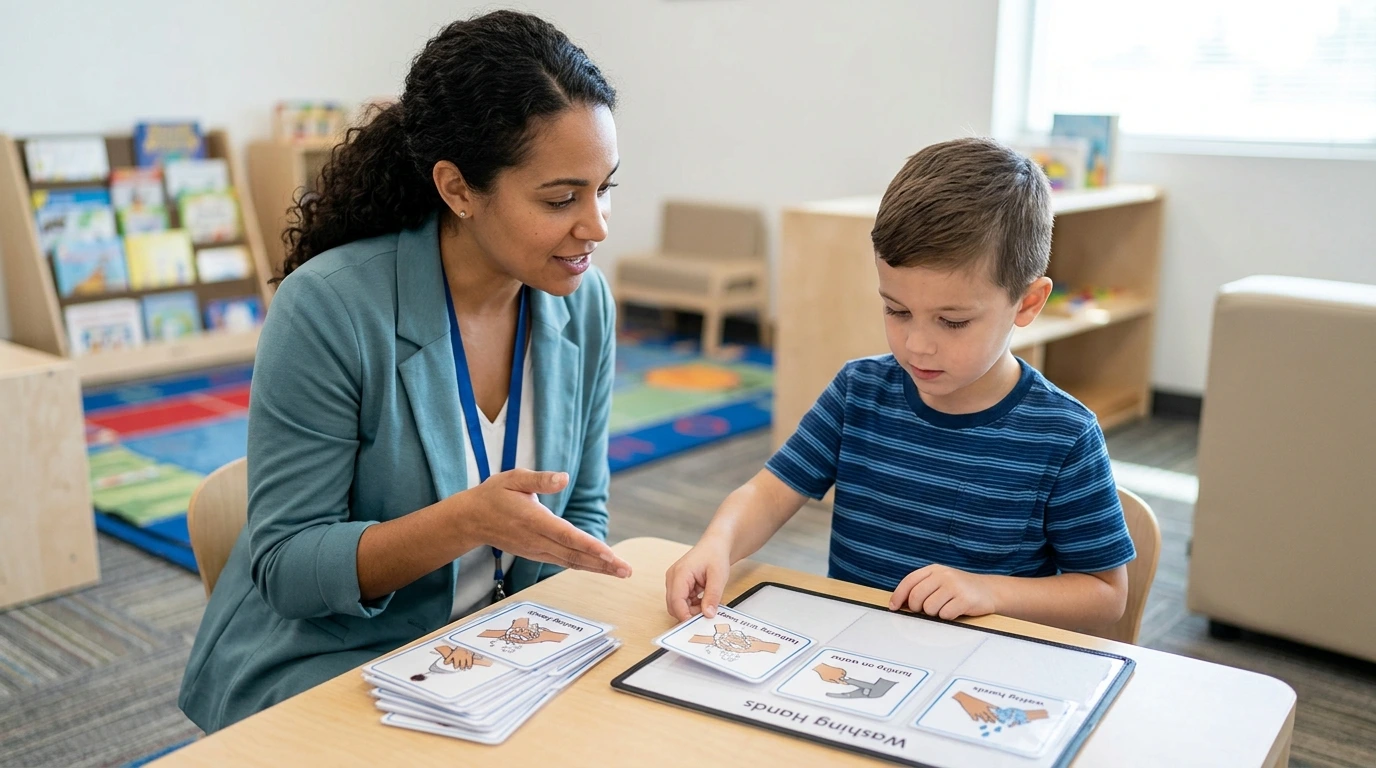
Thereafter, teaching begins once the list is complete. The practitioner demonstrates how to do the step, provides verbal or physical cues, reinforces the child’s performance when they successfully complete a step, and practices the routine repeatedly.
5. Track Progress and Adjust the Plan
In each practice session, the practitioner records the number of supports required for each step on each briefing. This information can provide an indication of whether the child is becoming more independent over time or not. When a child seems to struggle on one particular step for a time, the practitioner modifies the plan by dividing that extremely difficult step into smaller steps.
Assessing Task Analysis Performance
Progress is judged by observing the child’s performance in the sequence. In a practice session the practitioner makes notes of what steps the child can take independently, which steps they need support with and where the errors are occurring.
This performance can be tested in two ways:
- Single Opportunity Assessment: Child initiates the routine. When they make a mistake or stop, the test ends. The practitioner completes the remaining steps for the child and then documents the child’s performance level.
- Multiple-Opportunity Assessment: The child tries the whole routine. If they get stuck on step three, the practitioner helps them finish step three, and then lets the child try step four on their own.
By recording this information every week, practitioners know exactly when a child has mastered a skill, when to offer less help, or when to rewrite the step list.
Three Types of Task Analysis Chaining
Chaining is the actual process of teaching individual steps and linking them together into one fluid routine. There are three primary ways to do this.
Forward Chaining
In forward chaining, you teach the child the very first step on the list. Once the child can do step one on his own, you move on to step two. You keep moving forward down the list one step at a time. For example, when learning to brush teeth, the child first practices just reaching out and picking up the toothbrush. Once they master that, they move on to putting toothpaste on it.
Backward Chaining
In backward chaining, the parent or therapist completes almost the entire routine for the child, leaving only the final step for the child to perform. Once the child masters the final step, you teach them the second-to-last step, working your way backward. This approach works well because the child completes the task every time and immediately experiences the reward of being done.
Total Task Chaining
In total task chaining, the child practices every step of the routine from start to finish with each attempt. The practitioner steps in with help only on the specific steps where the child needs support. As the child improves, the practitioner provides less and less help until the child can complete the entire routine independently.
Task Analysis ABA Example
Let’s look at a detailed example to see how task analysis works in real life.
Example: Brushing Teeth
Here is how a basic toothbrushing routine can be broken down into ten simple steps:
- Get the toothbrush from the holder.
- Get the tube of toothpaste.
- Take the cap off the toothpaste.
- Put a small squeeze of toothpaste on the brush.
- Brush the front teeth.
- Brush the back teeth.
- Brush the top chewing surfaces.
- Spit the toothpaste into the sink.
- Rinse the toothbrush under the water.
- Put the toothbrush back in the holder.
A child might already know how to grab their brush (step 1) and turn on the water, but they might struggle to open the toothpaste (step 3) or remember to spit (step 8). The practitioner uses forward, backward, or total task chaining to help the child master those tricky parts. If ten steps feel like too much for the child to handle, the list can easily be shortened or simplified.
Task Analysis Examples Beyond Daily Hygiene
Task analysis is not just for bathroom routines. It can be used for almost any multi-step activity in a child’s day.
Daily Living Skills
- Getting dressed in the morning
- Making a simple buttered toast or snack
- Washing plates and cups in the sink
- Making the bed
- Sorting and doing laundry
Communication and Social Skills
- Raising your hand to ask for help
- Saying hello and waving to a classmate
- Taking turns during a simple board game
- Starting a short conversation with a peer
- Asking politely for a toy or snack
Academic and School Skills
- Finishing a page of homework
- Packing a backpack at the end of the school day
- Following a group routine during circle time
- Cleaning up and organizing a school desk
- Community and Independent Living Skills
- Picking out an item and paying at a store
- Ordering food at a counter
- Riding a bus or public transit
- Stopping and checking both ways before crossing the street
When Do ABA Practitioners Use Task Analysis?
Practitioners use task analysis whenever a skill has multiple steps, causes frustration, or feels too hard for a child to finish on their own. It is especially useful for skills that need to be done the exact same way every day, or skills that are important for a child’s safety and independence.
You will see task analysis used in homes, schools, therapy clinics, and out in the community.
It works best when the skill actually matters to the child’s real life, and when the steps are customized to match what the child can do today.
Conclusion & Next Steps
Task analysis breaks complex daily skills into small, teachable steps so your child can build real independence. Each step is personally tailored, easily tracked and designed to promote hygiene, school, social skills and safety practices.
Reach Higher ABA is dedicated to making every day a game-winner. We develop individualized therapies, specific to your child’s strengths and goals. Call Reach Higher ABA today and start your journey to lasting progress.